
5 Signs Your Bookkeeping May Need a Cleanup
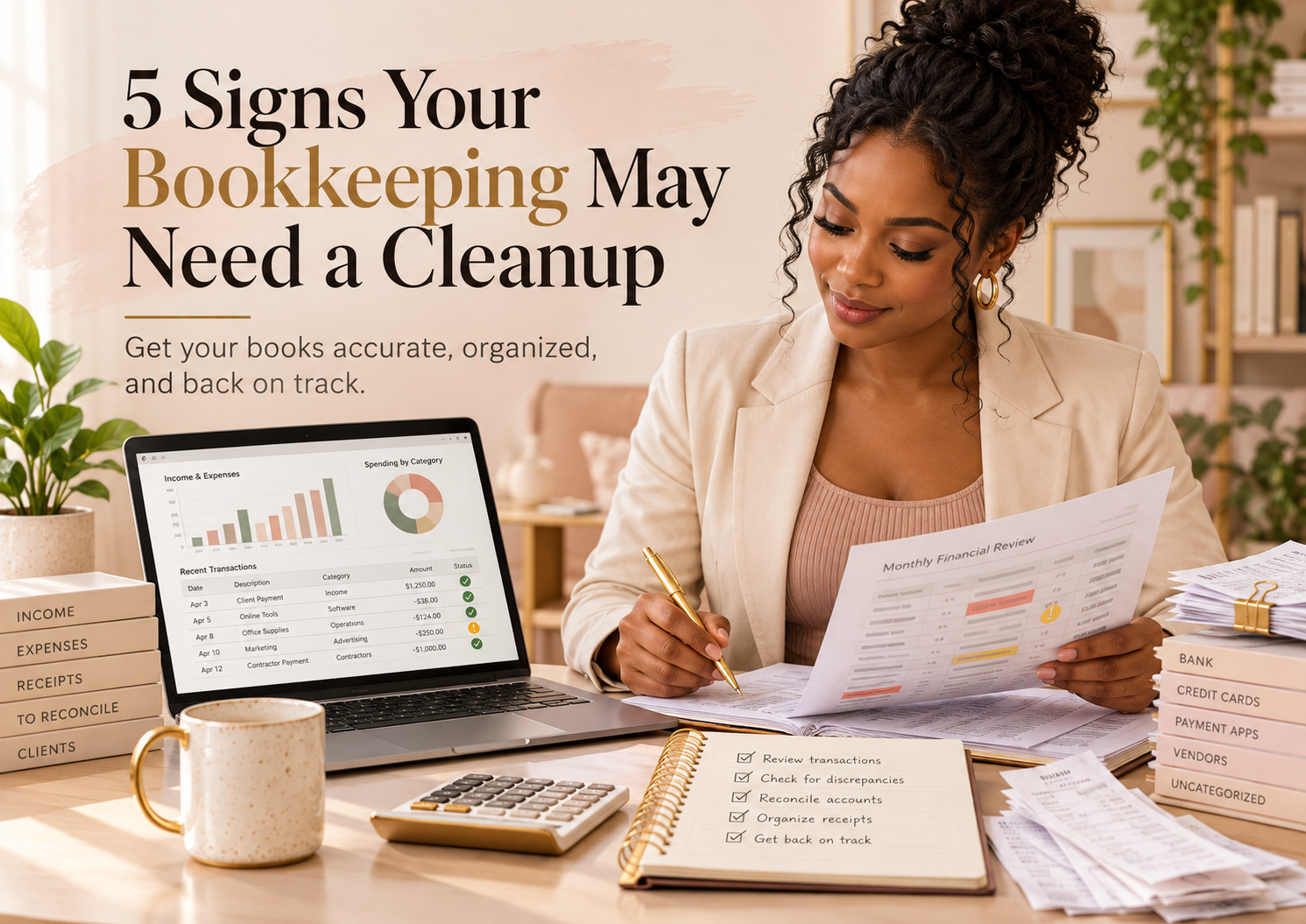
One of the things I’ve learned from working with business owners is that bookkeeping can look fine on the surface and still have problems underneath.
The bank feed is connected.
Transactions are coming into QuickBooks.
The Profit & Loss statement generates.
So naturally, you assume everything is okay.
But then we take a closer look.
Maybe the bank account hasn’t actually been reconciled in months.
There are transactions sitting in Uncategorized Expenses.
Stripe deposits are being recorded as income without accounting for the processing fees.
Old invoices are still showing as unpaid even though the customer paid months ago.
And suddenly, the financial reports you’ve been relying on aren’t telling the full story.
That’s why I remind business owners:
Having transactions inside your bookkeeping software doesn’t necessarily mean your books are accurate.
Here are five signs your bookkeeping may need a cleanup.
1. Your Bank or Credit Card Accounts Aren’t Reconciling
One of the first things we look at is whether the balances in your bookkeeping system properly reconcile to your actual bank and credit card statements.
For example, if your books show $15,000 in checking at month-end but the corresponding bank statement shows $11,500, we need to understand why.
There could be:
Missing transactions
Duplicate transactions
Incorrect opening balances
Transactions recorded to the wrong account
Old outstanding items that were never cleared
A difference doesn't automatically tell us what went wrong—but it does tell us something needs to be investigated.
2. You Have Transactions Sitting in Uncategorized Accounts
Take a quick look at accounts such as:
Uncategorized Income
and
Uncategorized Expenses
If you see transactions piling up there, your bookkeeping isn't finished yet.
Those transactions need to be properly classified before you can rely on your financial reports.
And categorization matters.
If expenses aren't recorded correctly, you may not have a clear picture of what it costs to operate your business—and you could potentially overlook legitimate business deductions when tax time arrives.
3. Stripe, PayPal, Square or Other Payment Processors Aren't Being Recorded Correctly
This is a common one.
Let's say a customer pays your business $1,000 through Stripe.
Stripe charges a $30 processing fee and deposits $970 into your checking account.
If you simply record the $970 bank deposit as sales, your books may understate both:
Revenue: $1,000
and
Merchant processing fees: $30
The $970 is simply what hit the bank after the fee was deducted.
Your bookkeeping should capture the entire transaction.
Payment processor activity should also be reviewed and reconciled so that what happened inside Stripe, PayPal, Square, or another platform ties back to what ultimately reached the bank.
4. Your Accounts Receivable Is Full of Old Invoices
Pull up your Accounts Receivable Aging Report.
Do you see customers who supposedly still owe you money from months—or even years—ago?
Before assuming you have money waiting to be collected, take a closer look.
Some of those invoices may have:
Already been paid
Been paid but the payment was never applied to the invoice
Been cancelled
Been duplicated
Required a credit
Become uncollectible and need further review
If your Accounts Receivable isn't accurate, your Balance Sheet can make the business appear to have assets that may not actually exist.
That's why I don't want business owners simply looking at a report.
I want the report to reflect reality.
5. Your Balance Sheet Has Negative Balances That Don't Make Sense
Not every negative balance is automatically wrong.
But unexpected negative balances deserve attention.
For example, if QuickBooks says your checking account is negative $8,000 but you know there is money sitting in the bank, that's a red flag.
The same applies when other asset accounts contain balances that simply don't make sense based on what you know about the business.
The Balance Sheet is one of the first places bookkeeping problems tend to reveal themselves.
Unfortunately, it is also one of the reports many business owners rarely review.
Here's the Bigger Issue
Bookkeeping errors don't always stay isolated to bookkeeping.
They can affect your:
Profit
Cash-flow decisions
Tax planning
Estimated tax calculations
Business deductions
Accounts receivable
Financial forecasting
Ability to understand how the business is actually performing
That's why clean books matter.
Good bookkeeping isn't just about making QuickBooks look organized.
It's about creating financial information you can actually trust.
Your Money Move This Week
Open your bookkeeping software and check these three things:
1. When was the last month every bank and credit card account was fully reconciled?
2. Do you have balances sitting in Uncategorized Income or Uncategorized Expenses?
3. Does your Balance Sheet contain anything that immediately makes you think, “That doesn't look right”?
If something catches your attention, don't ignore it.
It may simply need a small correction—or it may be a sign that the books need a deeper review.
Think Your Books May Need a Cleanup?
If your bookkeeping has fallen behind, your accounts haven't been reconciled, or you simply don't trust the numbers you're seeing, Ashade & Associates can help.
Our bookkeeping cleanup work is designed to help identify what went wrong, correct the books, and get your financial records organized so you can move forward with accurate information.
Because before we can plan or optimize, we first need to make sure the record is right.
Let's get your books cleaned up—and get you back to making decisions using numbers you can trust.